

Is the ERP Still in Charge?
Here’s what Retail’s Data Leaders Really Think
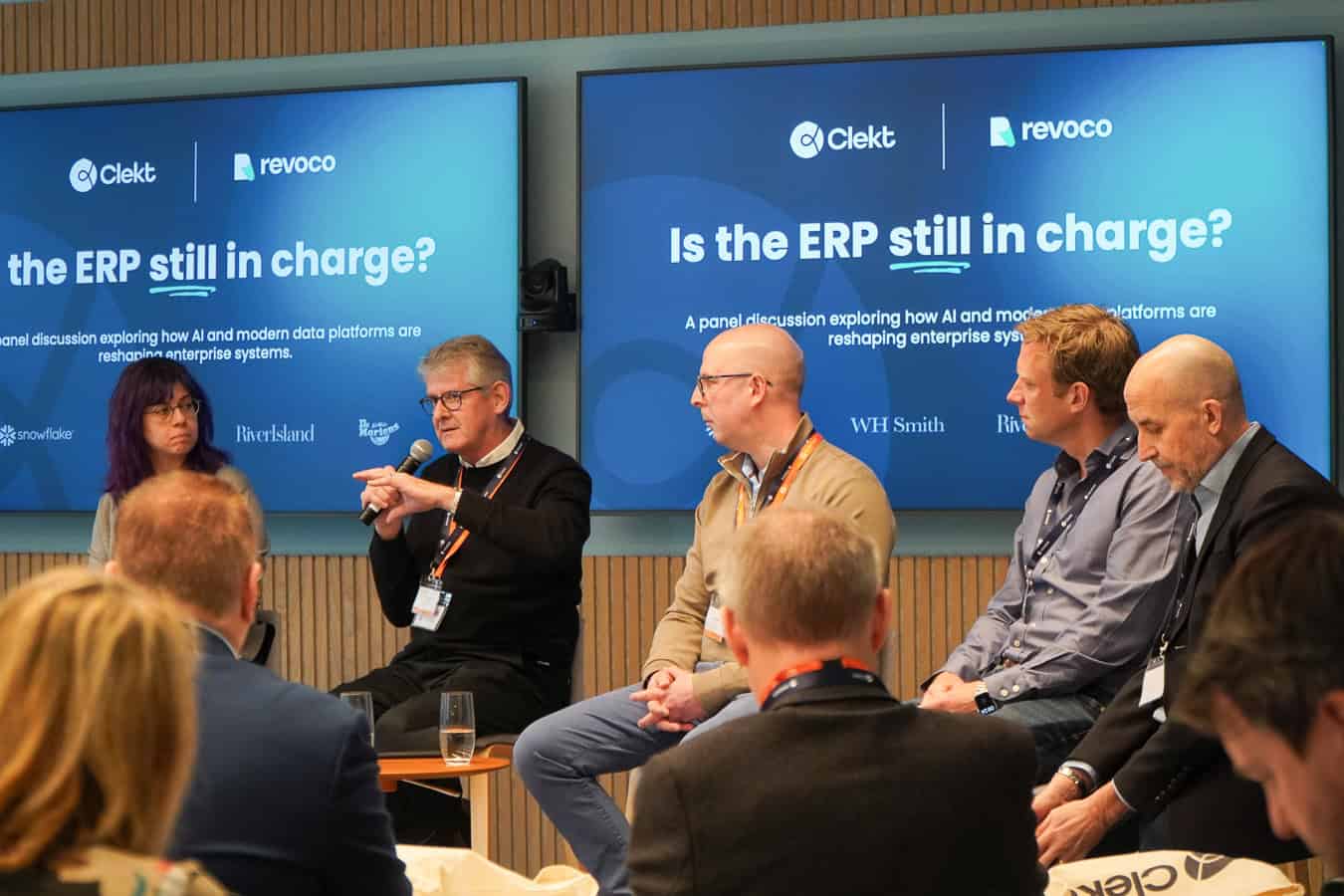
There’s a question quietly reshaping how retail organisations think about their technology foundations — and it’s not whether to invest in AI. It’s whether the systems that have anchored business operations for decades are still fit to lead. Recently, Clekt co-hosted a panel event at Snowflake’s London offices alongside Revoco, bringing together some of the most experienced voices in retail technology.
Chaired by Iain Blair; Founder of Revoco, the panel included Simon Pakenham-Walsh; CIO of River Island, Peter Swann; the Group Operating Director of WH Smith, Sezin Cagil, the Head of Unified Commerce Technology at Dr. Martens, Paul Winsor; Snowflake’s Head of Retail for EMEA, and Andy Tudor; CEO at Clekt. The question being asked: Is the ERP Dead? Is it still in charge?
The honest answer? It depends on what you’re asking of it.
The ERP Isn’t Dead — But It’s No Longer the Brain
TLDR: There was quick consensus that ERP systems still work.
Nobody’s pulling the plug immediately, but when asked where real decision-making intelligence actually sits today, the answer was revealing: Excel.
Despite millions of pounds spent innovating and creating new platforms and tools designed to make life easier and create a single source of truth, Excel remains the number 1trusted tool to store, validate and report on performance. The ERP, as one panellist put it, has been “sweated with an insurance line” — kept alive, extended, patched. Its value increasingly lies in what it was always best at: process integrity, data control, and providing a single, governed version of the truth. The problem is that those qualities — linear, rigorous, controlled — are exactly what makes it difficult to move at the pace modern retail demands.
The centre of gravity is shifting. The modern data platform is no longer just a reporting layer. It’s becoming the place where intelligence and decisioning live. And that’s a significant change for how organisations need to think about their architecture, their data, and their people.
Assisted Intelligence: AI That Works With Teams, Not Instead of Them
One of the most grounding moments in the conversation came when Clekt’s CEO Andy Tudor framed what we’re actually seeing in the market: AI being used in an assisted intelligence state – helping teams build trust in their data, make more effective decisions, and only then move towards operational automation.
That framing matters. It’s not about AI replacing the category manager, the merchandiser, or the supply chain analyst. It’s about giving those people better answers, faster. This is the practical, human-centred application of AI that actually gets adopted and not AI as a concept. AI as a tool that makes someone’s working day meaningfully better.
Paul Winsor, Head of Retail across EMEA for Snowflake rightly commented that a category manager shouldn’t have to wait until Monday morning to find out whether a competitor has undercut their pricing overnight. With the right data foundations and intelligent agents in place, that question can be answered before the morning coffee has been finished.
The Foundations Still Matter
One of the sharpest exchanges of the conversation centred on data quality — and whether AI changes the equation. Honestly? The panel was split.
On one side: organisations that have invested in clean, governed, structured data will be able to accelerate their AI adoption faster and with more confidence. On the other: AI’s inference capabilities are improving so rapidly that it may be possible to extract value even from imperfect data in ways that weren’t previously achievable.
But there’s a genuine risk buried in that optimism. AI is extraordinarily convincing, it speaks to you like a person and gives answers in plain language that feel authoritative. And that’s precisely why our panel emphasises human oversight, curiosity, and scepticism remain essential until the model is tested and proven its reliability.
Trust in AI has to be earned incrementally. That means data stewardship, domain ownership, verified queries, and business leaders who are willing to engage with the process — not just receive outputs.
The Human Change Is the Hard Part
Technology, it turns out, is often the easier problem. The harder challenge is organisational.
Retail businesses are finding that AI adoption doesn’t fail because the tools aren’t good enough. It stalls because sponsorship is absent, because siloed teams won’t share context, because people reach for their Excel sheet the moment an agent gives them two slightly different answers.
The panel was clear on what’s needed: top-down encouragement to experiment, joint ownership of data across departments, and a shift in mindset from “I’m responsible for this number” to “we’re collectively responsible for making better decisions.”
The organisations that will move fastest aren’t necessarily those with the most sophisticated data estates — they’re the ones where business leaders are genuinely curious, actively involved, and willing to be wrong in pursuit of something better.
What This Means in Practice
The ERP will remain part of the architecture. It streamlines business rules, maintains integrity, and provides the stable foundation that AI systems need to operate reliably. But it’s no longer the strategic engine. That role is being claimed by the intelligence layer — the data platform, the semantic layer, the agents that connect internal data with external signals and surface answers in natural language.
For organisations navigating this shift, the practical questions are less about which technology to choose and more about how to build the conditions for adoption: clean enough data, clear enough ownership, and people empowered to ask better questions.
And that’s where the real commercial value lies. Not in deploying AI because everyone else is, but in building the foundations that allow your teams to move with agility and report with confidence.