















Claude expertise, where it fits.
As an official Claude Partner, Clekt can help businesses identify where Claude’s Skills and Agents could solve real business challenges, then build, deploy and support solutions that deliver measurable value.
For some organisations, Claude will be the right fit. For others, particularly larger businesses with established data platforms, Snowflake’s AI capabilities, including CoWork, may offer a more appropriate route. Our focus is on understanding your needs and choosing the right approach for your business.
Identify the right AI use cases: We help teams understand what’s possible, identify practical use cases and prioritise by impact, feasibility and effort.
Build and deploy AI solutions: We design and implement solutions around business needs, with security and governance built in.
Build capability within your team: We provide hands on training to help your people use Claude or other AI tools such as Snowflake CoWork effectively and safely, building the skills and confidence to adopt new ways of working.
Measure the value: We help you track and articulate the business benefits of your AI initiatives, giving you a clearer picture of what is working, where value is being created and the return you’re getting from your investment.
Getting value from AI takes more than access to the technology. Our specialist expertise across Claude, Snowflake and data help you implement solutions securely, integrate them into your business and support adoption, while continuing to identify opportunities for innovation as your needs and the technology evolve.
Guiding Your Journey
You don’t need to implement AI everywhere. You need to know where it can make a meaningful difference to your business. When you choose to work with Clekt, you’re choosing a team that can help you identify the right opportunities, prioritise them based on potential value and create a practical path to implementation.
Whether you need to develop your AI strategy, identify opportunities for automation, explore Snowflake’s AI capabilities or build Claude powered workflows and Agents, we help you find a practical route from opportunity to implementation.
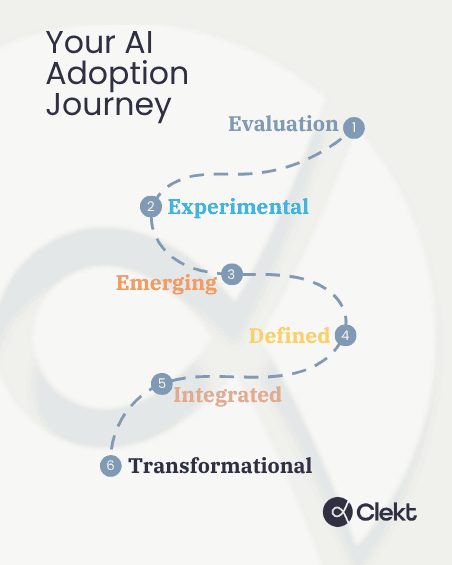
We do this through our EDIT framework which consists of 6 phases and is aligned to industry standards. The stages of maturity frequently perceived are as follows:
- Evaluation
- Businesses in this field will be interested in the opportunities AI could bring, but have no idea where to start. Clekt can help you to identify AI opportunities in your business and map a realistic and achievable strategy with data quality considerations in mind.
- Experimental
- Businesses in this stage have little to no initiatives, guidelines and processes in place for teams to adopt AI. There is likely poor data quality and a significant amount of Shadow AI in the organisation due to a lack of AI strategy and vision. Clekt can help you to identify targeted areas of opportunity along with guidance for process implementation to create a roadmap for successful adoption.
- Emerging
- Businesses here are starting to augment AI into their operations and applying discipline as to usage. We’ll likely see pilots being launched to solve specific business problems. For these organisations, Clekt can help to prioritise the most impactful AI project to ensure investment is made into the right areas against standardised frameworks to ensure consistency.
- Defined
- The organisation is going through a period of change to realign their people, processes and platforms to accommodate AI adoption. A formal AI strategy will be created to align teams. At this point, Clekt can assist with AI project management, delivery and adoption to ensure teams are understanding of the technologies and embracing the change proposed.
- Integrated
- The business has overcome the most significant stage of change management and is stepping into the largest opportunity zone in terms of ROI. As AI becomes embedded and accountability is being defined, Clekt can assist those responsible to deliver successful and optimised projects against agreed KPIs to ensure ROI.
- Transformational
- The organisation has adopted autonomous AI practices and is aligning AI investment against its P&L through controlled measures and processes – proving that AI is central to its competitive positioning. Clekt is able to bring specialist knowledge to identify the next wave of opportunities within the business.
Why are AI initiatives failing to deliver value?
AI adoption is growing, but using AI and successfully integrating it into the business are two different things.
The UK Government’s 2026 Business Data Survey found that only 31% of small and medium sized businesses using AI said their AI tools were integrated with existing business systems, compared with 57% of large businesses.
In this episode of Clektive Thinking, Chris Harling and Elliott Fairhall explore how businesses can move beyond experimentation and take a practical approach to implementing AI, from identifying the right opportunities and technology to putting the right foundations in place


How we prioritise your AI initiatives
In our first discovery session with a new client, our teams typically surface dozens of potential AI use case opportunities. That’s an exciting finding — and a real challenge in equal measure.
The potential for meaningful, tangible growth is almost always there. But most organisations are working within real constraints: time, budget, and resource don’t stretch infinitely. The question isn’t whether AI can help — it’s where to start.
That’s where Clekt’s prioritisation framework comes in. Designed to cut through the noise, it scores each opportunity against three things that genuinely matter: how achievable it is, the impact it’s likely to deliver, and whether that impact is proportionate to the effort involved.
The result? A clear, practical roadmap that helps your team focus on the AI initiatives most likely to move the needle — and builds the momentum to keep going from there.
From AI opportunity to business value
Our approach brings together strategy, data, technology and people to help you move from promising ideas to AI solutions that are practical, adopted and delivering measurable value.
As Snowflake and Claude partners, we can help you identify the right technology for your needs, whether that’s using AI capabilities within your existing data environment, exploring Snowflakes CoWork or building Claude powered workflows and Agents.