

From Data Transformation to AI Transformation: Why the Shift Matters for Retailers
A conversation with Ben Tunstall, Director of Consumer Industries at Snowflake
For much of the last decade, retail and CPG organisations poured investment into platforms, migrations, and specialist talent in pursuit of the goal of becoming data-driven. For many, the results were harder to measure than expected. Confidence was slow to build and the goalposts kept moving.
As Director of Consumer Industries at Snowflake and one of the longest-serving UK employees, Ben Tunstall has been in a unique position to witness some of the biggest retail data transformations globally and watched as over an 8-year period the priority shifted from becoming data-driven to now – achieving AI transformation.
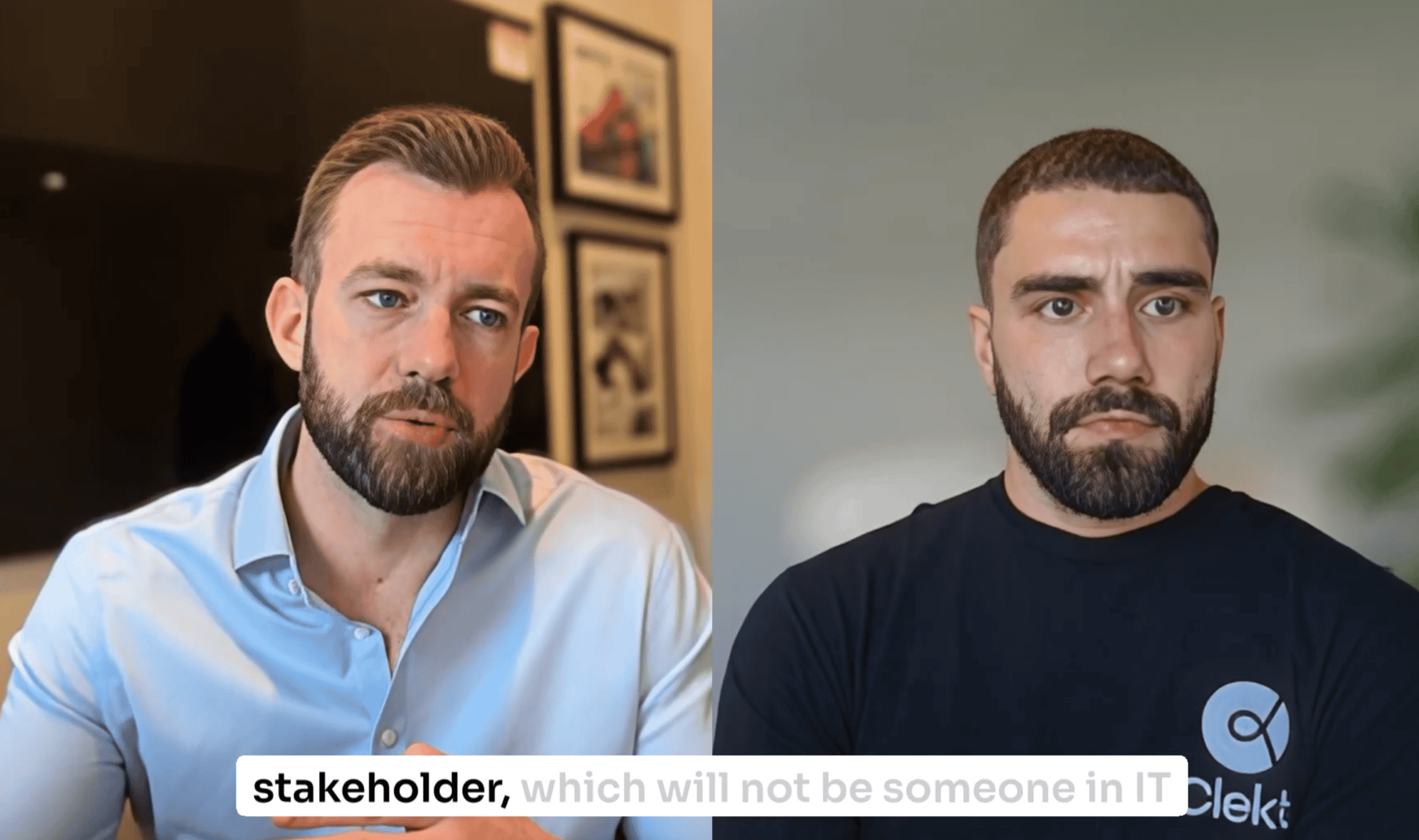
In this episode of Clektive Thinking, Ben joined Clekt’s Chris Harling to explain where the real opportunities lie right now for retail and CPG brands, what leaders should be doing about them, and why the rules of the game have changed more dramatically than most realise.
The answer has changed — but so too has the question
Back in 2018 and 2019, the challenge for most organisations was straightforward if not simple: legacy systems needed replacing, data needed moving to the cloud, and analytics needed building.
“Those problems felt complex at the time”, Ben reflects, “what’s changed isn’t just the technology — it’s the sheer scale of value that data and AI can now unlock.”
The platform conversation has evolved in three distinct waves, according to Ben. First, abstracting complexity away from data warehousing and engineering. Second, enabling data sharing — inside organisations and across entire ecosystems — which gave retail in particular a distinctive commercial edge. And third, what Ben describes as upstream AI: technology that assists the people doing the work, not just the downstream output of that work.
The surprising advantage of starting fresh
One of the more counterintuitive perspectives Ben shares is that organisations who haven’t yet made significant investment in big data transformation may actually be in a stronger position than those who have. After a decade of effort, many CDOs are walking into conversations weighed down by fatigue — investment that hasn’t clearly moved the needle on competitive advantage or market share.
For the organisation writing its data strategy from scratch today? There’s no baggage. And more importantly, the human capital equation has fundamentally shifted.
“Industry and vertical and organisation-specific skills are now becoming more valuable for a data professional to have than data skills specifically. The only programming language I know is English — and I build data applications regularly.”
This is more than a catchy line. It points to a genuine structural change. The expensive, specialist-heavy data team that was once the price of entry is no longer the only path forward. AI-assisted development has lowered the bar to entry so dramatically that domain expertise now matters more than technical depth. For retailers with large workforces of non-technical staff, this unlocks possibilities that simply didn’t exist two years ago.
AI: Empowering people at every level
This is the thread that runs most powerfully through Ben’s perspective, and it aligns closely with how we think about Assisted Intelligence at Clekt. The opportunity isn’t to replace human intervention, it’s to remove the bottlenecks that slow the process down.
Ben describes tools like Snowflake Cortex Code delivering something close to a 20x increase in output for data teams. This is not achieved by replacing people, but by eliminating the lag between business demand and data delivery. In retail, where that bottleneck has historically been most acute, the downstream impact is significant.
“You’re trying to make everyone data-driven in previous years. Well, people don’t go home and refresh Tableau in their own life. But whether you’re working on the shop floor of John Lewis or you’re the CFO of Diageo — you’re using ChatGPT or Claude every single day. You’ve already trained yourself to be a prompt engineer.”
This is a point worth sitting with. Organisations are not starting from zero as their teams are likely already using AI tools in their personal lives, already developing intuitions about how to prompt and query and iterate.
The challenge for leaders isn’t mass enablement from scratch, it’s providing the secure, business-grade environment to harness what’s already there. The workforce is more ready than most executives realise.
Ben illustrates this with a live example from a large retailer Snowflake has been working with. A store manager who was previously dependent on centralised merchandising, promotional, and pricing teams can now ask, in real time: what product should I put where? What should my stock levels be this week? How should I price this to stay competitive?
Decisions that once took weeks of planning can now be made on a Tuesday morning and reviewed by Wednesday. The shift from data as a function to data as a capability can be put in the hands of every employee – not just the data team. This is what meaningful transformation actually looks like.
Where data sits in the organisation matters
A theme that emerged strongly in the conversation is the structural question of where data sits in the leadership hierarchy. Ben’s view is clear: the CDO should report directly to the CEO, sit on the executive board, and be viewed as a value centre — not a support function buried under a CIO.
“The minute an organisation top-down views data as an asset, as a product, a value centre — the sooner that’s apparent, the faster things move.”
It’s a mindset shift as much as a reporting line change. When data is treated as infrastructure, decisions about it get made slowly, buried in technology planning cycles. When it’s treated as a commercial asset, it gets the sponsorship, the urgency, and the ambition it deserves.
Key Takeaways
- The AI transformation program is replacing the data transformation program.
- Rather than expensive, years-long data migration and platform overhauls, forward-thinking CDOs are leapfrogging straight to AI transformation which touches every employee, not just the data team.
- Late movers may have the upper hand.
- Organisations without a decade of sunk investment and accumulated fatigue can build a leaner, faster, more modern data strategy. This is built around AI from day one rather than retrofitted onto legacy architecture.
- Your workforce is already AI-enabled.
- People are using AI tools in their personal lives every day. The enablement curve is shorter than most leaders assume. The job is to provide the right tools and environment – not to start from scratch.
- Start with a measurable business outcome, not a technology problem.
- Find one use case tied to a real commercial metric (revenue, cost, waste, margin etc) prove it end-to-end, earn the confidence, and build from there. Don’t boil the ocean.
- Data needs a seat at the top table.
- The CDO reporting to the CEO isn’t just a nice-to-have. It signals to the entire organisation that data is a product, not a by-product and that signal changes how fast everything else moves.
The bottom line
The organisations setting themselves apart right now aren’t the ones with the biggest data budgets or the longest transformation roadmaps. They’re the ones that have found the right use case, tied it to something measurable, and backed themselves to move.
That’s the kind of gumption that separates the organisations building genuine competitive advantage from those still waiting for the right conditions to arrive. At Clekt, it’s exactly the approach we bring to every engagement — pragmatic, outcome-focused, and built around the people doing the work.
As a Premier Snowflake Services Partner, Clekt launched its Clektive Thinking podcast series to explore data, AI, and the human stories behind transformation. If you’d like to find out how these ideas apply to your organisation, we’d love to have the conversation. Get in touch using the links below.