

The AI-Ready Retail Product Cycle: What Retailers Need to Rethink
How retailers can rethink their Retail Product Cycle to unlock greater value from AI.
In this blog, we have partnered with the team at First Friday to explore where AI can have the greatest impact across the retail product cycle.
What will you take away?
By the end of this blog, you’ll have a clearer view of what AI could mean for the way your commercial teams work, and where to start.
1. Where AI can make the biggest difference across the retail cycle
From strategy and planning through to buying, trade and learning, we explore practical use cases where AI can augment decision making, reduce manual analysis and help teams move faster.
2. Why your retail product cycle processes matters as much as your technology
AI will only deliver value if your people, processes, data and systems are set up to support it. We look at why retailers need to rethink how teams work together, not simply add AI to existing ways of working.
3. What it takes to become AI ready
We explore the foundations retailers need to put in place, from trusted data and governance to AI literate teams, and share five questions you can use to assess how ready your own commercial operating model is for AI.
Who are Clekt?
Clekt designs and builds data and AI solutions that help organisations turn data into better decisions and measurable business outcomes. We are a Premier Snowflake Service Delivery Partner, we work with organisations to create practical solutions that connect teams with the insights they need, by ensuring their data foundations, technology and operating models can take drive AI at an enterprise level.
Who are First Friday?
First Friday work with clients who are looking to transform their business, often with new tools and technology – they provide subject matter expertise, change management and training to retailers who are on transformation journeys whether that’s from excel to software, or on to cutting edge AI innovation. All of their consultants come from a retail background so they are able to work with commercial teams to build effective processes and systems are adopted in the real world. Even in the age of AI it remains true that how functions collaborate through the retail cycle needs to be be effective and clear.
What is a Retail Cycle?
A Retail Cycle is a series of steps or processes, by function, that describe the collaboration required to deliver how you want to work.
- High level view of how the moving parts of the business – people, process and systems fit together to deliver value.
- Creates a clear and shared vision of how a business will run.
- Invaluable when
- Implementing a new system
- Restructuring
- Responding to market shifts
- Combining multiple businesses into one
- Aligning ways of working across multiple customer facing brands
- Defining decisions which will be made globally and which taken locally
It sets the framework and guiding principles, while providing a clear starting point for identifying the actions needed to move from how you operate today to how you want to operate in the future. It is a critical input into the change process.
The 6 Stages of the Retail Cycle
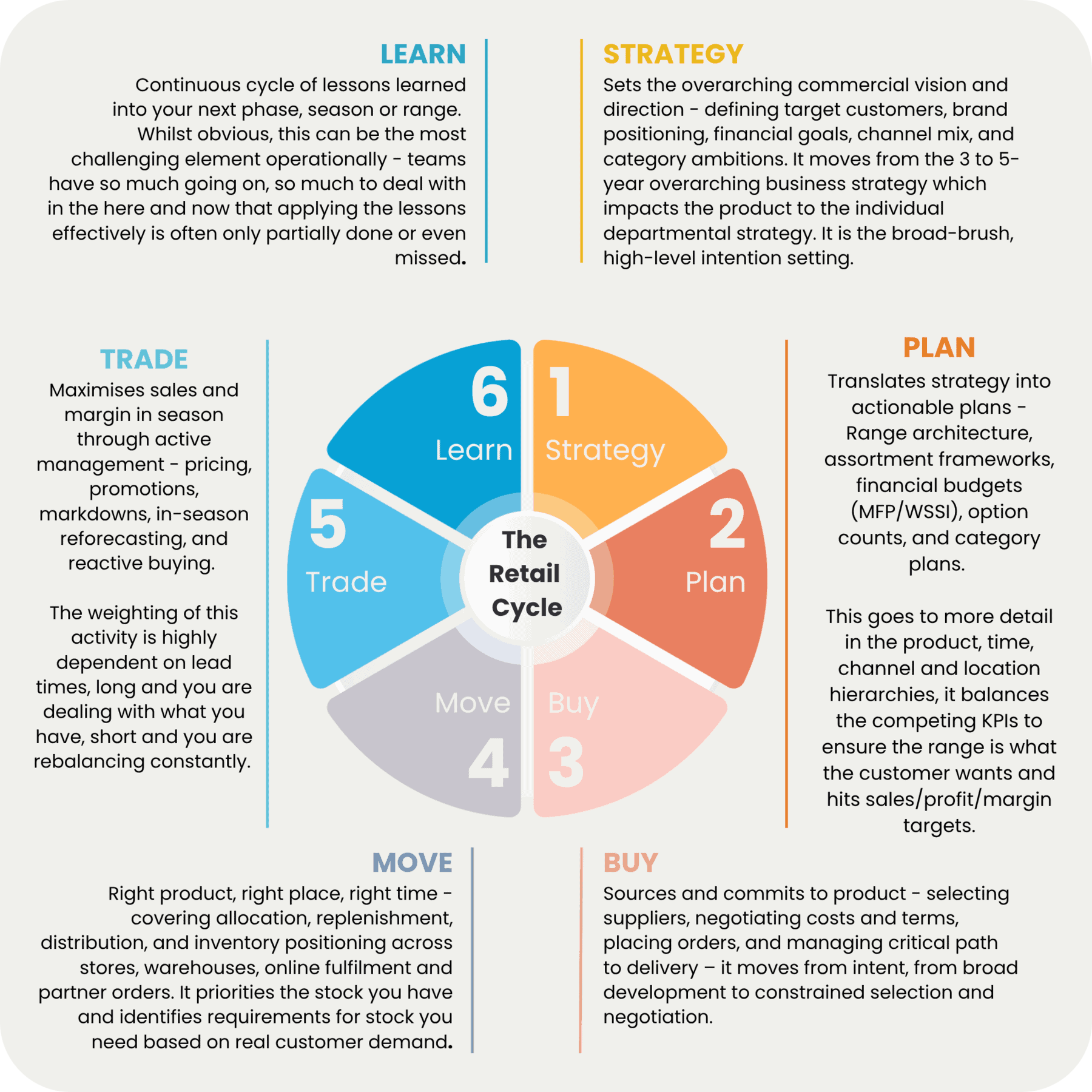
Underpinning all these stages are capability, data, tools and collaboration with a timeline driven by the constraint of product lead times.
High-impact use cases across the retail cycle
AI enables unparalleled breadths and depths of data to be analysed, interpreted and summarised into meaningful recommendations on which actions can be taken. As one CIO said to Victoria Ward at First Friday recently “no retailer lacks data, we all have masses of it, more than we can handle!” Retailers need to know where their data is and how to make it accessible to AI.
The more well governed and trusted your data is, the better AI can use it. And the more AI-literate your teams are, the greater the value they can unlock from it.
Agentic AI can help move commercial decision-making beyond the traditional “black box” approach. Rather than simply producing a recommendation that teams may not understand or trust, it can explain the key factors and wider commercial context behind its actions. The result is greater transparency, confidence and trust, making teams less likely to override AI recommendations and inadvertently undermine their value.
Let’s take the 6 stages of the Retail Cycle and work through the key ways AI can be deployed:
1.Strategy
AI Use Case: Validated Direction Setting
There are so many internal and external factors which affect strategy, such as macro economics, trends, supply chain and sourcing, customer insights and capability.
Whether you are looking at the high level 3-to-5-year company strategy or the next season departmental strategy, all the above factors will play a role and there is a massive amount of data sitting behind each element which needs to be evaluated.
Retailers can use AI to:
- Mine publicly available data and surface patterns, correlations and potentially causations that link to their business.
- Combine this insight with internal data to guide and evaluate strategies.
Rather than a few people looking at a narrow set of factors, AI can provide broad, detailed, valuable and thought-provoking insight for people to review, debate and action. Many clients find strategy the most squeezed element of the Retail Cycle so spending the time debating rather than researching is a massive win, and that’s before you consider the breadth of insight it brings.
2. Plan
AI Use Case: Micro-cohort / behavioural customer segmentation
Turning that strategy into plan, moving into product, time, channel and region hierarchies is a time consuming and a commercially demanding job. Bringing together MFP/WSSI (Merchandise Financial Planning / Weekly Stock Sales and Intake) planning with space, grading, trends, missed sales, really requires a merchandiser and buyer to have traded the previous season, to have seen and remembered the learnings.
With AI, those lessons can be surfaced in much more granular detail:
- Finding patterns in huge amounts of data; e.g. capturing the lost sales by size, grade, week, looking at cannibalisation, moving Easter / EID, normalising extreme weather.
- Evaluating the probability of success in using trend data, competitor data and even academic models.
CASE STUDY: One software provider who has an AI enabled Assortment Planning tool recently shared that when they briefed AI to create a new fashion range it was black, grey and white with only the most boring continuity shapes.
What this teaches us is that AI still lacks the creative flare needed to keep moving the range forward and take calculated risks. but it is giving designers more scope to experiment; reducing lead times, waste and cost in sampling. By combining AI-analysed granular customer data like multi cohort / behavioural customer segmentation, with human-led creative expertise, retailers can move beyond static demographic data to better understand and respond to increasingly more diverse customer demand.
3. Buy
AI Use Case: Machine Learning driven demand forecasting, inventory optimisation and distribution planning
Buying well is about balancing many different factors – cost, quality, reliability, sustainability etc, and in a fast-moving geopolitical situation these can all be impacted repeatedly through a buying cycle. Having the ability to crunch through the many inputs coming at buyers is a fantastic user case for AI – helping them truly evaluate where and when to place the buy. Many retailers have been using Pareto curves (Ranking) to manage option width and depth for decades, and this continues to be the underlying principle of most Assortment Planning systems. But few, if any, were able to manage global assortments effectively and with sufficient visibility for commercial teams – who must justify their decisions as well as make them.
AI supports the buying stage by:
- Using historic data to make effective baseline recommendations.
- Giving the buying and merchandising teams edit options rather than having to create a full region / territory specific range build from scratch.
- Evaluating and recommending the mix of global / regional options that are appropriate and helping to manage the number of options.
- Giving first views earlier in the process to connect design and buy more effectively.
And planograms – essentially a mathematical puzzle, it is perfect for AI – though it still needs to be refined and confirmed by a human to ensure the decision is both logical and appealing.
Machine learning has been driving demand planning systems for some years with developments, further enabling stock optimisation, insightful distribution planning and speed in supplier / partner sharing of data – totally transforming the speed and accuracy of decision making.
4. Move
AI Use Case: Improved stock optimisation
AI is probably the most developed at this stage, particularly on Demand and Replenishment tools. It’s where we first started to see algorithms come through – with an established range and a continuous flow of data, there’s a rich environment for AI to react to changing demand and optimise decisions.
- Work with the clearly defined parameters of a Demand system / process – prioritisation, lead-times, cost / benefit of stock moves etc.
- Consume and amalgamate vast detail across multiple countries / regions / business models and make reasoned recommendations.
This is the game changer. So many demand and replenishment implementations have failed – not because they weren’t good systems but because they were “black box” and needed time to properly embed within the organisation. Without proper implementation, users don’t fully understand the capabilities of the system, they start to build workarounds, and you eventually end up with a spaghetti no-one can unravel. AI agents explain and recommend; they do the heavy lifting and guide, but the people stay in charge and retain visibility.
5. Trade
AI Use Case: From trade data to action
The same principles applied in planning around customer segmentation can be applied in trade, helping retailers target specific customer groups whilst maintaining quality perception. AI can bring these principles into the trade cycle, helping teams move from data and analysis towards clearer recommendations and faster decisions.
The focus is not simply on generating commentary, but on creating practical actions that teams can debate, refine and act on. As retailers become more comfortable with AI, the opportunity is to build governance around these processes, turning proven prompts and recommendations into repeatable ways of working.
6. Learn
AI Use Case: Make better decisions, faster and get ahead of the competition
AI is accelerating the learning cycle and enabling retailers to react quicker to what the data is telling them. There is no longer that segmentation between systems and job roles, meaning leaders can choose to make data as accessible as they would like it to be across the business, in a way that can be instantly interpreted and fed into decision making – whether that be customer data derived from a loyalty programme, competitor data and sales, profits and markdown data. The learning cycle is quickly becoming the acting cycle.
- Data – well organised, effective and accessible data is the key to being able to maximise the AI revolution we are all living.
- People – developing our teams to see AI as a team member, as part of their tool kit, training them on how to maximise the opportunity and focus on continual development.
- Start now – take the first step and make AI part of your daily workflow.
How AI-ready is your Retail Cycle?
If you’re a retailer trying to navigate this change and get ahead, you can start to understand how AI-ready your Retail Cycle is by considering these five questions:
- How is AI being adopted in your own business, and how is this reflected within your industry?
- How is AI or automation impacting business decisions made within your organisation right now?
- Which departments, teams and/or individuals use AI in their day-to-day role?
- How are data and technical systems managed? Does governance play a part?
- If you use AI, how do you measure its success?
The question for retailers is no longer simply “Where can we use AI?” but “How should our commercial organisation operate differently now that AI is possible?”
Take the first step on your AI journey
The pace of change when it comes to AI is relentless and how you respond to developing your use of AI is no longer optional. Our advice is not to overthink it, but to start small. Reviews of trade reports and agents who make recommended actions is an easy entry point. It can be refined over time as confidence grows and understanding deepens.
Once you’ve begun to understand the art of the possible and the challenges that surface, you can start to review the Retail Cycle and identify AI use cases within your specific business model.
The answer will look different for every retailer, but the foundations are consistent: trusted data, strong governance, AI-literate teams and an operating model designed to combine human expertise with increasingly capable AI and other machine learning.
The opportunity is to move from using AI to designing for AI, embedding it into the way commercial decisions are made, processes are run and value is created.
Is your commercial operating model ready for that shift?
Look out for future blogs in our AI leadership series. Our next blog with First Friday will look at how AI is changing the working week for merchandisers and what practical changes retailers can make to have the biggest impact.
Ready to take the next step in your AI adoption journey? Speak to us about an organisational AI maturity assessment today.
Need help with your AI journey? Please contact us to discuss how we can help.